Klaviyo MCP: Start With a Read-Only Retention Review

Begin with a retention question you can verify
Klaviyo publishes documentation for its MCP server. The safe first use is not “improve retention.” It is a bounded read-only review that names the audience, time window, metric, and decision owner.
For example:
Review the last complete month of the post-purchase flow. Show eligible recipients, sends, delivery outcomes, placed-order evidence, and the current flow configuration that affects timing. Flag missing evidence; do not change the flow.
That request makes it possible to review what was analyzed and what was not. It also avoids treating an attributed-revenue total as a complete customer or business outcome.
Use a read-only retention review contract
| Field | What to define | Why it matters |
|---|---|---|
| Decision | Investigate, hold, or propose a test | Prevents a vague optimization request |
| Population | Flow, campaign, or named segment | Avoids mixing audiences |
| Time window | One complete period plus comparison | Avoids partial timing artifacts |
| Evidence | Delivery, conversion event, and commerce cross-check | Separates a message outcome from a sale outcome |
| Constraints | Consent, suppression, frequency, and brand rules | Keeps the proposal customer-safe |
| Owner | Lifecycle operator and approver | Makes accountability visible |
Klaviyo’s account configuration and event semantics matter. Where a conclusion depends on a provider setting, verify it in the current connected account and Klaviyo documentation instead of relying on a generic recommendation.
Separate attribution from realized sales
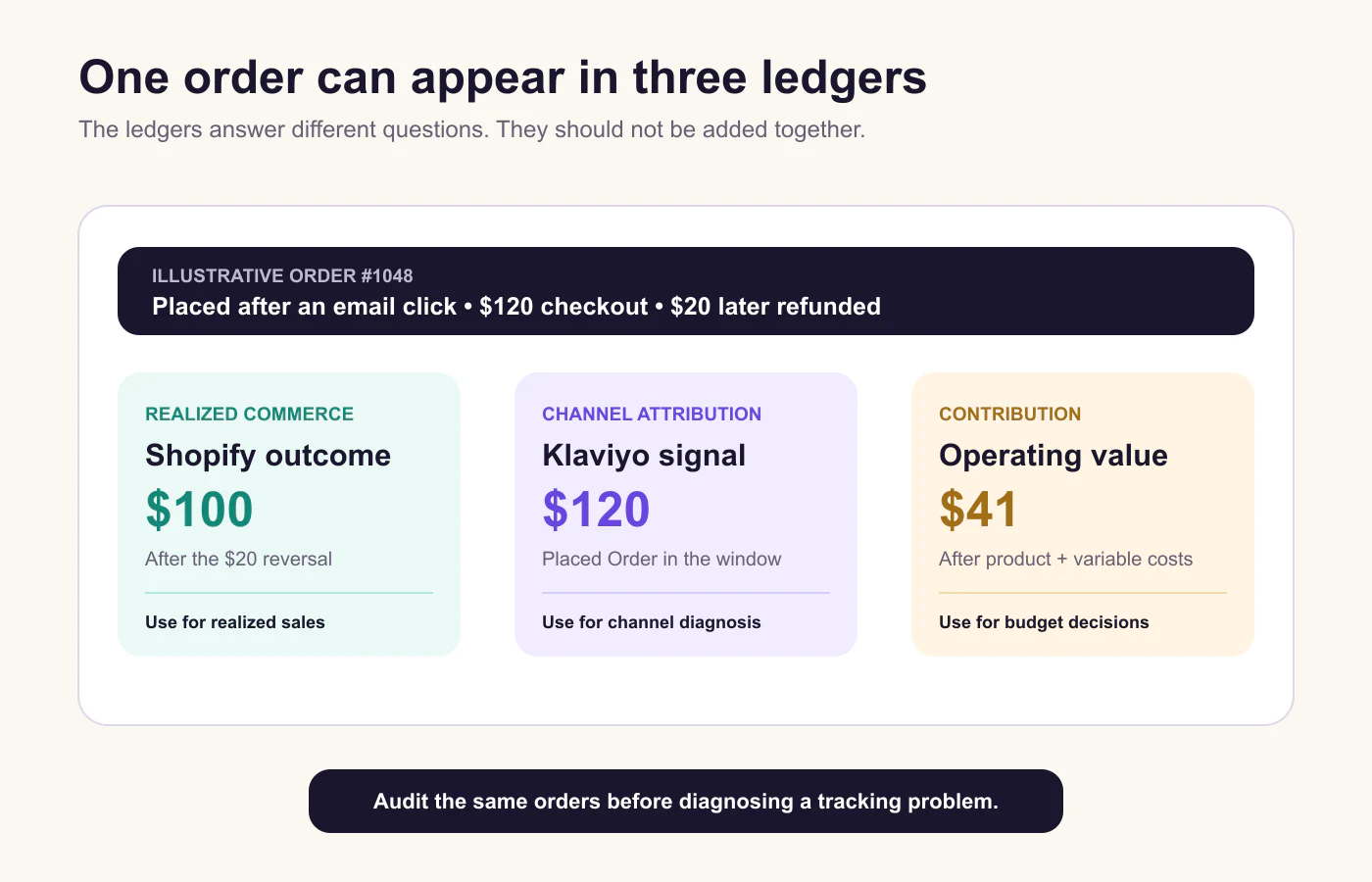
Klaviyo can attribute eligible conversion events to messages under account settings. Shopify records commerce outcomes under its own report definitions. The same order can be represented differently across those systems, especially around attribution windows, refunds, dates, and channel overlap.
Before recommending a retention change, audit a small, varied set of orders and compare the message event, the conversion event, and the Shopify order outcome. The full five-order method is in Klaviyo vs Shopify revenue: why the numbers do not match.
Propose a test, not a silent flow edit
| Finding | Safe proposal | Evidence still needed |
|---|---|---|
| Delivery weakened | Inspect consent, suppression, and deliverability conditions | Whether the audience or content changed |
| Conversions weakened | Compare eligible audience and commerce cross-check | Whether inventory, offer, or attribution moved |
| Segment size changed | Review membership rules and data availability | Whether the rule change was intentional |
| Evidence is incomplete | Repair or document measurement first | Any performance conclusion |
For any material message change, show the existing condition, proposed condition, affected audience estimate, intended outcome, and rollback plan. The operator should confirm the change before it is applied.
What BizSidekick should and should not do
BizSidekick can prepare an authorized-data evidence pack, distinguish measured facts from inference, and produce a reviewable next step. It should not promise autonomous customer messaging, a guaranteed retention lift, or a complete attribution answer from one report.
For retention analysis that also involves paid media and product availability, connect the decision to the ecommerce automation guide and the out-of-stock advertising workflow. When the evidence is ready, prepare a governed retention review with the responsible lifecycle owner.
Keep reading
Continue with a guide that supports your next ecommerce decision.