Klaviyo Abandoned Cart Flow: Audit Before You Change the Journey

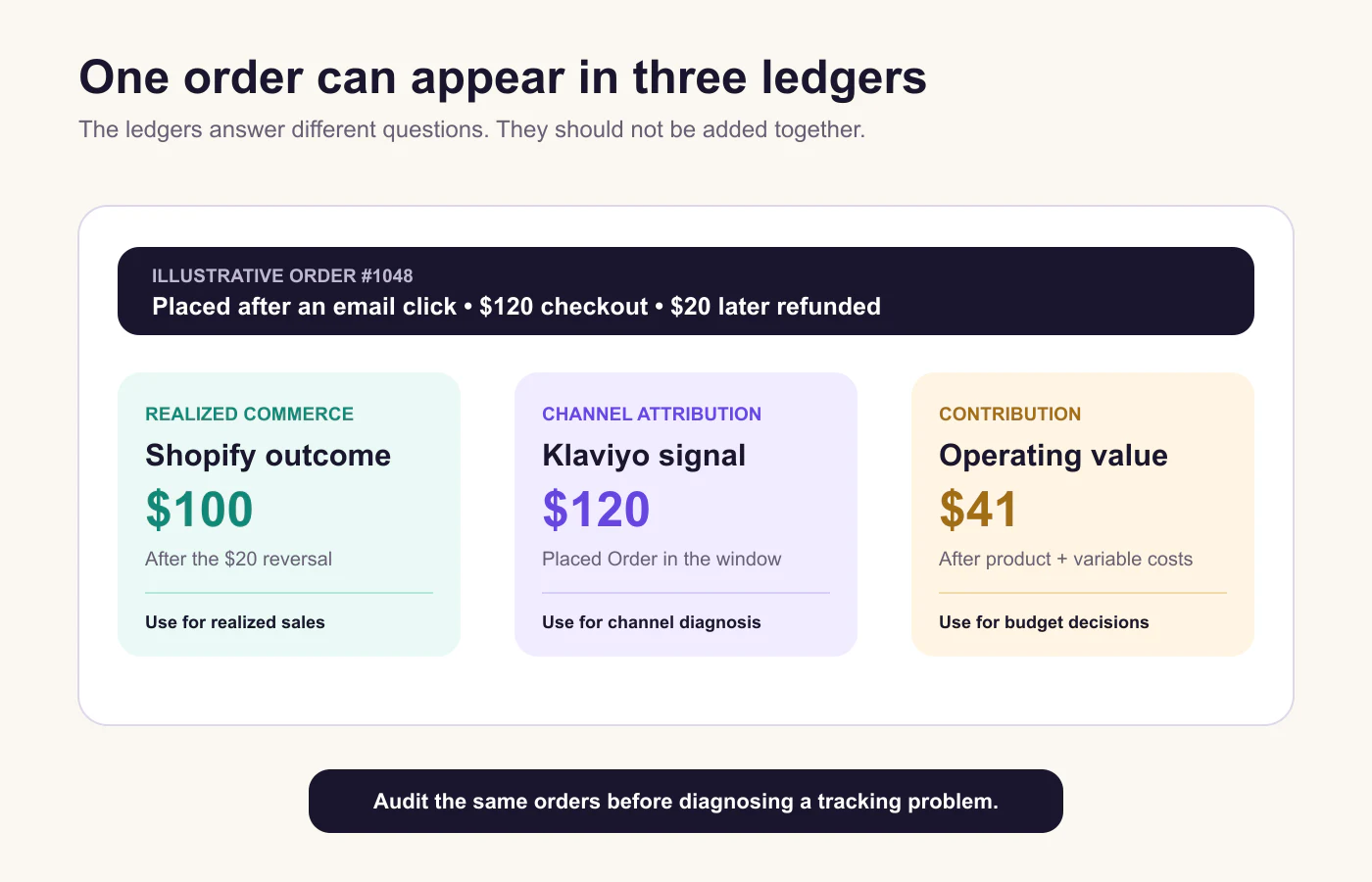
Audit the recovery journey before “optimizing” it
An abandoned cart flow is not just an email sequence. It is a customer journey with a trigger, waiting period, audience rules, content, exit conditions, and a measurement definition. A change to any one of those parts can create duplicate messages, send to the wrong population, or make a before-and-after result impossible to interpret.
Klaviyo’s current abandoned-cart guide covers creation, timing, cart content, and prevention of messages after a purchase. Shopify’s abandoned checkout automation guidance explains that its automation has channel and consent limitations and includes a permanent migration choice. Read both as provider behavior, then decide which system owns the customer journey in the actual account.
Choose one owner for each recovery journey
“Use Shopify and Klaviyo” is not an ownership rule. Write down who sends what and why.
| Question | Shopify-native automation | Klaviyo flow | What the operator must decide |
|---|---|---|---|
| Trigger | Abandoned checkout in the provider’s supported scope | Event and flow definition in Klaviyo | Which event begins this journey? |
| Audience | Provider eligibility and email settings | Flow filters, segment rules, and consent | Who can receive it? |
| Timing | Automation wait settings | Flow delays and branches | When does a message become helpful rather than intrusive? |
| Exit | Checkout/order conditions in the provider | Purchase and flow filters | What stops the next message? |
| Measurement | Automation performance view | Flow delivery/conversion view | Which evidence supports a decision, and which is attribution only? |
The answer can be “Shopify owns this journey,” “Klaviyo owns this journey,” or “each owns a clearly separate use case.” The unsafe answer is leaving both active without documenting exclusions.
Verify the five rules that prevent a misleading test
1. Trigger
Name the event, channel, and scope. Shopify notes that its abandoned checkout automation does not cover every sales channel. Klaviyo’s event and integration behavior must be checked in the connected account. If the team cannot say what starts the journey, it cannot explain who was eligible.
2. Eligibility and consent
Document the recipient rule. Shopify’s guidance notes a default email-marketing subscription condition for the automation and permits changes in the provider. Do not broaden a recipient rule merely to increase a send count; the owner must verify consent and the intended channel.
3. Delay and content
Record the current delay, the message’s return-to-cart behavior, and the offer or product facts that appear in it. A shorter delay is not automatically better. Test a clear hypothesis, such as whether shoppers who have not purchased after a defined window need a clearer product reminder—not whether “more messages” creates more revenue.
4. Purchase suppression and latest-cart handling
Confirm what happens when the customer buys before the delay ends, creates another checkout, or completes the order on a different device. This is the rule that stops a useful reminder from becoming a contradictory message.
5. Evidence and rollback
Define the success measure before editing. Include delivery, eligible recipients, order evidence, refund treatment where relevant, and the comparison period. Record how the team will restore the prior configuration if a test needs to stop.
Use a test-order evidence ledger
Before activating a material change, run a controlled test order or provider-supported preview and retain the evidence.
| Check | Expected result | Evidence to retain |
|---|---|---|
| Eligible checkout | Enters the intended journey once | Event or automation run ID |
| Ineligible checkout | Does not receive the message | Eligibility and consent condition |
| Delay | Sends only after the documented interval | Timestamped delivery result |
| Purchase before send | Exits the journey | Order and suppression evidence |
| Cart link/content | Represents the intended cart and offer | Preview or test message |
| Measurement | Uses the declared comparison window | Baseline and owner |
The ledger is more useful than a generic “best practices” list because it lets a reviewer see exactly what was tested and what was not.
Make the proposed change reviewable
A good flow-change request has five parts:
- The current trigger, audience, delay, and exit condition.
- The proposed change in plain language.
- The affected population and consent boundary.
- The expected evidence window and success/failure rule.
- The owner who approves, monitors, and can roll back the change.
BizSidekick can help assemble authorized Shopify and Klaviyo evidence into this review. It should not activate, duplicate, or edit a customer journey without the responsible owner’s approval. For the broader retention-analysis boundary, read Klaviyo MCP: Start With a Read-Only Retention Review.
A prompt for a controlled audit
Audit the current abandoned-cart recovery journey for the last complete period. Show the owning provider, trigger, recipient eligibility, consent rule, delay, purchase-exit rule, message count, and available delivery/order evidence. Flag possible duplicate coverage with another automation. Propose one test only; do not activate or edit a flow.
This starts with the real configuration and gives the lifecycle owner a clear point of review.
FAQ
Should I add a discount to every abandoned cart message?
Not automatically. First establish the audience, current offer, margin boundary, and test hypothesis. A discount can change both customer behavior and the economics of the recovered order.
Why did a shopper not receive an abandoned cart message?
Check the actual provider’s eligibility, sales-channel scope, consent setting, timing, and whether the shopper completed a purchase before the send. Do not infer a delivery failure from a missing attributed order.
Can one report prove that the flow created the sale?
No. Provider attribution supports a useful performance view, but order evidence, timing, and attribution settings still need to be clear. See Klaviyo vs Shopify revenue for an order-level audit approach.
Use BizSidekick in your AI apps
BizSidekick can prepare a read-only recovery-journey audit from authorized connected data in ChatGPT, Claude, WorkBuddy, and more. The lifecycle owner reviews every proposed change before it is applied.
Keep reading
Continue with a guide that supports your next ecommerce decision.